"We talked about the launch. Sam will follow up. Aim for October."
That might jog your memory this afternoon. Read it six weeks later and you will have to reconstruct the meeting: which launch, what Sam agreed to do, whether October was a deadline, and what the team actually decided.
A useful project note should spare you that reconstruction. Write it for someone who knows the project but missed this conversation. That person may be you.
Put the current state near the top
Start with the project name, the date and a sentence about its current state. "Waiting for a venue quote before choosing a workshop date" tells you more than "Workshop update."
Include the note's scope when it might be mistaken for a complete record. A planning call about venue costs does not settle the workshop's budget, invitations or schedule unless those things were discussed and agreed.
Keep the summary short enough to update. The rest of the note can hold the detail; the opening should help you decide whether you have found the right record.
Separate a decision from an attractive idea
"We could run two sessions" and "We agreed to run two sessions" describe different states. Put possible approaches under Ideas until someone has actually made a decision.
For each decision, record what was chosen and why. Add who made or confirmed it if that matters to the project. A rejected option is worth a sentence when you can imagine someone proposing it again.
You do not need a transcript of every objection. Keep the constraint that explains the choice: "We chose one session because the available room is free for only one afternoon." If that constraint changes, you will know what to revisit.
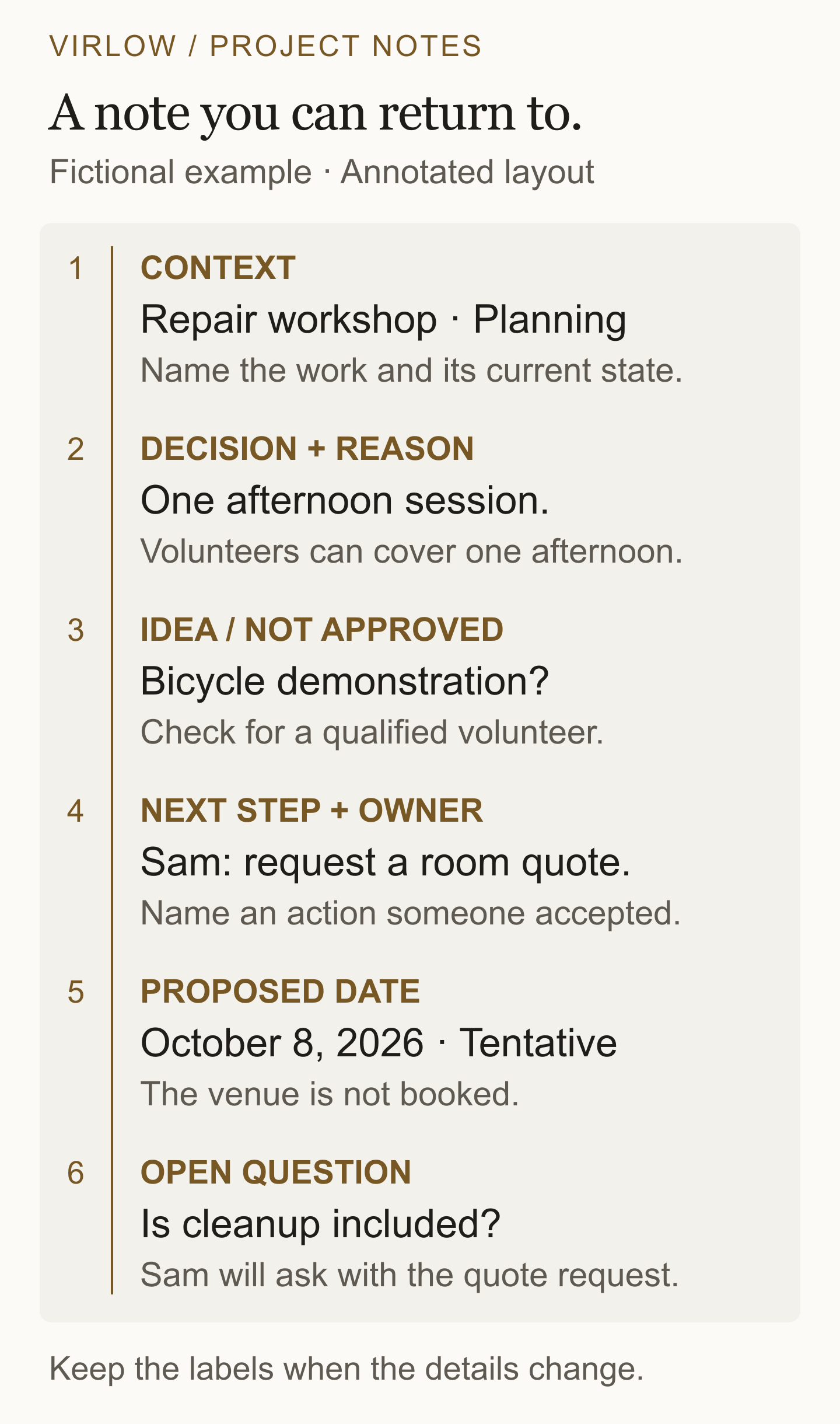
The layout gives each kind of statement a place. Context identifies the work. A decision records a choice and its reason. An idea remains a possibility. A next step names an action and its owner. A proposed date stays tentative, and an open question stays visibly unanswered.
Give the next action a clear owner
"Follow up with the venue" leaves a handoff unfinished. "Sam: request a written room quote" names both the person and an observable result.
Do not turn a suggestion into an assignment. If Sam has not accepted the task, write "Proposed owner: Sam; awaiting confirmation." For your own notes, the owner can simply be "Me."
Treat dates with the same care. Label a date as proposed, agreed or dependent on something else. Write "October 8, 2026, proposed workshop date; venue not booked" rather than letting an optimistic date look like a commitment.
A task's due date and the event date are separate facts. If neither is known, write "not set" instead of supplying a plausible date to fill the space.
A template to copy
Delete sections you do not need. Keep the labels when mixing them up would change what someone does next.
Project:
Note date:
Current state:
Scope of this note:

Decisions
- Choice:
  Reason / constraint:
  Decided or confirmed by:
  Alternatives considered, if useful:

Ideas (not approved)
- Possibility:
  What would need to be checked:

Next steps
- Action and expected result:
  Owner:
  Owner confirmed? Yes / no
  Due date and status: agreed / proposed / not set

Proposed dates (not commitments)
- Date and purpose:
  What must happen before confirmation:

Open questions
- Question:
  Who will investigate, if agreed:

References
- Source or document, with enough context to find it:

Changes since the last note
- Date / what changed / why / earlier decision affected:
A fictional example
The following workshop, people and dates are invented. They illustrate the template, not a real project or a tested product workflow.
Project: Neighborhood repair workshop
Note date: September 17, 2026
Current state: One session planned; venue quote still needed.
Scope: Planning call about session length and venue costs.

Decisions
- Choice: Plan one afternoon session.
  Reason: The volunteer team can cover one afternoon only.
  Confirmed by: Sam and Lee during the planning call.
  Alternative: Two sessions; revisit if more volunteers join.

Ideas (not approved)
- Add a short bicycle-maintenance demonstration.
  Check: Is a qualified volunteer available?

Next steps
- Action: Request a written room quote from the library.
  Owner: Sam (confirmed during the call).
  Due date: September 21, 2026 (agreed).

Proposed dates (not commitments)
- October 8, 2026: proposed workshop date.
  Confirm after checking room and volunteer availability.
  The venue is not booked.

Open questions
- Does the room fee include cleanup?
  Sam will ask when requesting the quote.
- What is the spending limit?
  Investigator not yet assigned.

References
- Volunteer availability list, revision September 16, 2026.
  Saved with the workshop planning documents.

Changes since the last note
- First planning note; no earlier decision replaced.
The unassigned spending question is deliberately unfinished. It is more useful than an invented owner or an implied budget. The bicycle demonstration is also still an idea, even though it sounds like a reasonable addition.
Update the record without erasing the reason
When plans change, update the current-state sentence and add a dated change entry. If the library quote is too high, record the new choice and what it replaces. Keep the earlier reason available rather than silently rewriting the note as if the latest plan had always been the plan.
At the next project check-in, read the open questions and next steps first. Mark completed actions, confirm tentative dates, and remove ideas that no longer deserve attention. You can preserve an old idea in a brief change entry if its rejection needs explaining.
Before closing the note, check whether someone returning to it could tell what is settled, what is proposed and who agreed to act. Fix any sentence that requires you to remember the conversation to understand it.
If you later ask an AI assistant to summarize these notes, check its answer against those distinctions. A proposed date should not become a deadline in the summary. Before sharing the content, read what happens to private notes when you connect an AI assistant; a well-organized note can still contain information you do not want to send to a provider.